THE RHODY STRENGTH PODCAST
NSCA STATE CLINIC RHODE ISLAND
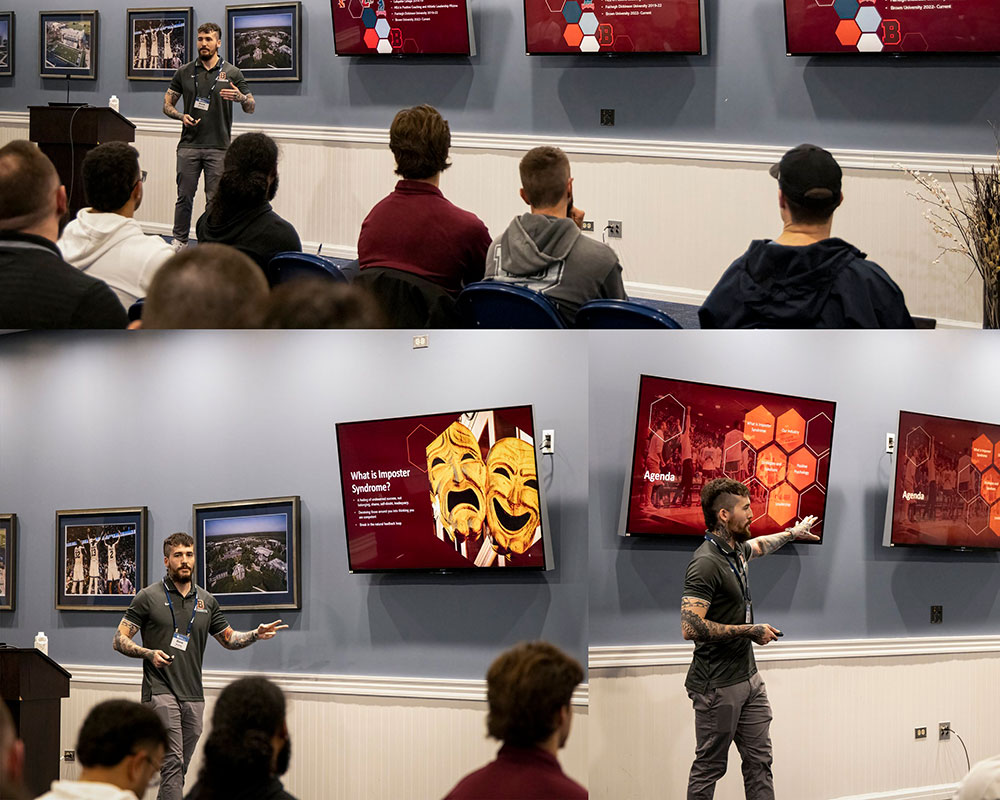
Super proud to be a part of the Rhode Island NSCA State Clinic last weekend. Scott Leech, the head of URI put on a great line up of speakers, sponsors, and the food was great. Super grateful to be able to share my story with everyone there!
Imposter syndrome is something that I definitely continue to deal with, and after bombing a presentation last year that started the idea for this book, it was a big milestone for myself to be able to speak in front of my colleagues, peers, strangers, about my journey and what they can do to improve their own version of imposter syndrome.
Amazing to see how many people it effects, and hopefully we can grow together!
-Dave Downey RSCC MEd
RI State NSCA Clinic
WHAT'S IN THE BOOK?
-
Early Career
- We dive into my start, from undergrad into internships and the private sector. What it's like to go from school to working in the field.
-
Earning the Logo
- Rising as a collegiate assistant strength and conditioning coach. Becoming a paid intern, and being promoted to an assistant director of strength and conditioning.
-
Changing Gears
- Refining a career path. Becoming a leader and head strength coach. Defining and narrowing a specific focus, or carving out your niche in the field.
-
Imposter Syndrome
- What is it? What types might you run into and who does it affect?
-
Fueling the Fire
- How does our industry create this issue? What cultural areas encourage and strengthen the imposter mindset?
-
Strategies
- What are solutions that the individual can act on? We'll look at how to break the negative feedback loop that reinforces imposter syndrome.
- Includes worksheet
-
Positive Psychology
- We explore the area of the zero point. If healthy is the lack of disorder, how do we begin to thrive or push above the zero point? Positive psychology is the study of this often-overlooked area of well-being.
-
Leadership
- How does your leadership style unite or divide your follower group? What other styles are there? Then we will dive into individual character strengths to maximize your effectiveness.
-
Conclusion/Extras
- Having strategies to avoid or overcome imposter syndrome is our goal. We then delve into creating a solid framework of coaching leadership to refer back to whenever imposter syndrome rears up again.
- Worksheets and examples are also included.
-Dave Downey RSCC MEd
BEGINNER MINDSET
Most of us have interns, volunteers, or graduate assistants on staff; how we teach them will determine the culture and direction of our field. Beware of the phrase, "This is how it has always been done." Hearing that shows a lack of critical thinking and evolving with the times. Being treated poorly by the coaches that came before is not a good reason to treat the coaches after you in the same way.
A coach I know was tasked with reviewing a needs analysis and developing a macrocycle with an intern. He went as in-depth as possible, using every five and six-syllable word he could come up with in a conversation that should have been very basic. Is any of that knowledge actually imparted on the intern who has never heard anything like triphasic, isometric, undulating periodization going to stick? Probably not, she just got an endless list of words she needs to look up and the coach was just flexing his "knowledge."
This scenario can be avoided if coaches check their egos, and learn to keep a beginner mindset. Coaches must always be learning if they want to get ahead, but remember that dumping an encyclopedia on the equivalent of a toddler doesn't help at all. I do my best to try to learn a new activity every year. This feeling of starting from scratch on something I've never done before allows me to keep in mind what it is like to know nothing about something. Not only does this help when I have to teach other potential strength coaches, but it helps with my athletes as well. It is easy to take for granted how long and how focused we are on the weight room. Remember that most people do not do this for a living. Keep in mind how hard it is to start something new, and handle those who want to be a part of what we do with grace.
-Dave Downey RSCC MEd
WHAT IS IMPOSTER SYNDROME?
Imposter syndrome is an issue that manifests as self-doubt in ability, skills, and achievement. The idea that you are undeserving of success or praise. A person with imposter syndrome does not believe when someone tells them they did a good job but convinces themselves that they have deceived those around them into thinking they are competent.
This issue affects everyone at some point, for example, in situations like starting a new job, moving to a new area, or a difficult challenge. The standard feedback loop is altered with imposter syndrome. Someone without it will see a challenge, experience negative thinking, gain success, and have that negative thinking reduced. In contrast, someone with imposter syndrome will not reduce their negative thinking but increase them. Every win is added pressure to maintain the "illusion" of competence. This, in turn, will cause the person to work harder and harder, often gaining more success, adding more pressure.
Over time, this becomes debilitating and can lead to other more serious mental health issues. Dive into the book to learn more!
-Dave Downey RSCC MEd